
Blogs > Tips for Answering Dosage Calculation Questions in Nursing
Tips for Answering Dosage Calculation Questions in Nursing
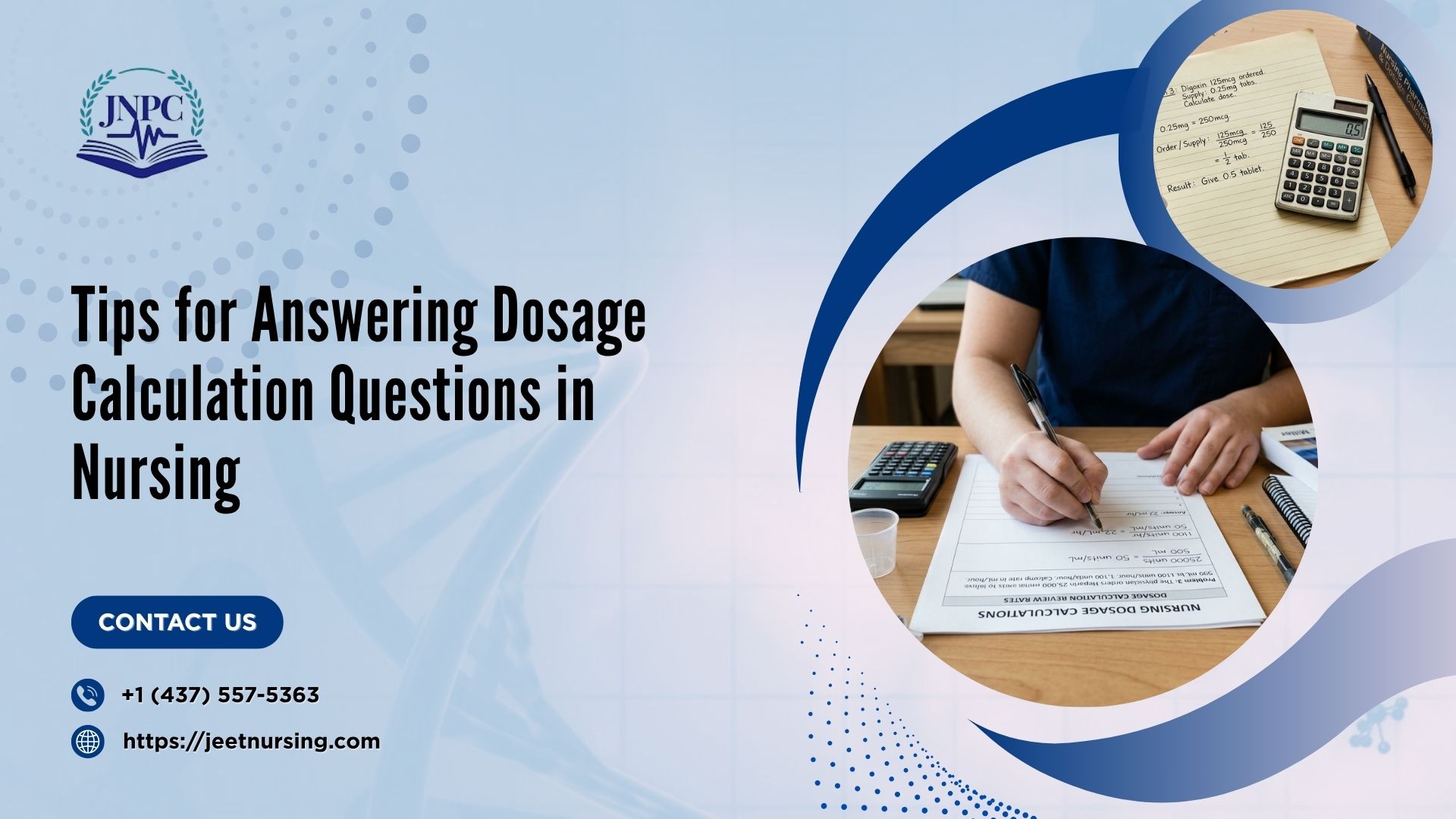

If there's one topic that makes nursing students break into a cold sweat, it's dosage calculations. A single misplaced decimal or a missed unit conversion can turn an easy question into a costly mistake and on exam day, that mistake could cost you the whole test item. Whether you're studying for a med-surg final or working through your NCLEX preparation, mastering dosage math isn't optional. It's a core clinical skill that follows you from the classroom to the bedside.
The good news is that dosage calculation questions almost always follow the same handful of patterns. Once you understand the formulas, practice the setup, and build a habit of checking your units, these questions stop being scary and start becoming free points. This guide walks through the methods, formulas, and exam-day habits that make dosage calculations manageable - no matter which method your instructor prefers or how the question is worded.
Why Dosage Calculation Skills Matter in Nursing
Dosage calculation isn't just an academic exercise, it's a patient safety skill. Medication errors tied to incorrect dosing are among the most common and most preventable causes of adverse drug events in clinical settings. A tenfold calculation error, a missed weight-based adjustment, or a wrong IV rate can lead to overdose, under-treatment, or a dangerous drug reaction. That real-world weight is exactly why nursing programs and licensing bodies test this skill so heavily.
You'll encounter dosage math questions in more places than you might expect:
Nursing school exams — nearly every pharmacology and med-surg course includes calculation-based test items.
NCLEX-RN and NCLEX-PN — dosage and IV calculation questions appear throughout the exam, often as fill-in-the-blank items with no answer choices to fall back on.
Clinical med-surg rotations — instructors and preceptors expect you to calculate and verify doses at the bedside, not just on paper.
Next Generation NCLEX (NGN) case studies — newer item types embed dosage math inside multi-part clinical judgment scenarios, so a calculation mistake can affect more than one question at once.
Because these questions show up everywhere, building strong dosage calculation habits early pays off across your entire nursing prep journey, not just for one exam.
Nursing Dosage Calculations & Conversion Chart
Nearly every dosage calculation question depends on knowing your conversions cold. Keep this chart handy while you practice nursing dosage calculations:
Memorizing these isn't enough on its own - you need to practice applying them inside real dosage calculations until the conversion step becomes automatic. Most calculation errors happen not because a student doesn't know the formula, but because a unit got converted incorrectly (or not at all) somewhere in the middle of the problem.
Core Dosage Calculation Methods (with Worked Examples)
There are three standard methods taught for dosage calculations, and most nursing programs let you pick whichever one clicks for you. Here's how each one works.
Method 1 — Desired Over Have
This is the most commonly taught formula because it's fast and simple:
Desired ÷ Have × Quantity = Amount to give
Example: The order is for 500 mg of a medication. The stock available is 250 mg per tablet.
500 mg ÷ 250 mg × 1 tablet = 2 tablets
Method 2 — Ratio and Proportion
This method sets up two equal ratios and solves for the unknown value (x).
Have : Quantity = Desired : x
Example: Available stock is 250 mg per 5 mL. The order is for 500 mg.
250 mg : 5 mL = 500 mg : x
Cross-multiply: 250x = 2,500, so x = 10 mL
Method 3 — Dimensional Analysis
Dimensional analysis lines up all your units in a single equation so they cancel out, leaving only the unit you need in the answer. It's especially useful for multi-step conversions.
Example: The order is for 0.5 g of a medication, and the stock is labeled 250 mg per tablet.
0.5 g × (1,000 mg / 1 g) × (1 tablet / 250 mg) = 2 tablets
Notice that the "g" and "mg" units cancel each other out, leaving "tablet" as the final unit - a built-in check that your setup is correct.
Weight-Based and Pediatric Dosage Calculations
Weight-based dosing shows up constantly in pediatric nursing, oncology, and critical care, and it introduces an extra step most students forget: converting the patient's weight before doing any math.
Formula: Ordered dose (mg/kg) × Patient weight (kg) = Total dose
Why lb→kg conversion always comes first: Medication orders are written in mg/kg, but patient weight is often documented in pounds, especially in the U.S. If you skip the pound-to-kilogram conversion (or do it after calculating the dose), your final number will be wrong - even if every other step was correct. Always convert weight to kilograms as your first move, before you touch the dosage formula.
Pediatric worked example: A pediatric patient weighs 44 lb. The order is for 10 mg/kg/day, divided into two doses.
Step 1: 44 lb ÷ 2.2 = 20 kg
Step 2: 10 mg/kg × 20 kg = 200 mg/day
Step 3: 200 mg ÷ 2 doses = 100 mg per dose
Note on checking against max safe dose ranges: Weight-based calculations don't end once you have a number. Always cross-check your calculated dose against the medication's safe dosage range for that patient's weight and age. If your answer falls outside the safe range, stop and recheck your math (or flag the order) before administering - a calculation that's technically correct but clinically unsafe is still a problem.
IV Flow Rate and Drip Factor Calculations
IV calculations ask you to figure out how fast fluid should run, either in mL/hr or in drops per minute (gtt/min).
mL/hr formula:
Total volume (mL) ÷ Time (hours) = Rate (mL/hr)
Drip rate formula:
(Volume (mL) × Drop factor (gtt/mL)) ÷ Time (minutes) = Rate (gtt/min)
Example: Infuse 1,000 mL over 8 hours using tubing with a drop factor of 15 gtt/mL.
Step 1: 1,000 mL ÷ 8 hr = 125 mL/hr Step 2: (1,000 mL × 15 gtt/mL) ÷ 480 minutes = 31.25, rounded to 31 gtt/min
Always double-check the drop factor printed on the IV tubing package - macro-drip and micro-drip sets use very different numbers, and mixing them up is a common source of error.
Top Tips and Safety Rules for Exam Day
A few consistent habits make the biggest difference when you sit down to answer dosage calculation questions under time pressure, whether that's during a practice quiz or on your actual exam date:
Read the question twice- The first read is for context; the second is for extracting the exact numbers, units, and what's actually being asked.
Write out every step- Don't try to do it in your head. A written setup lets you catch mistakes before they become your final answer.
Avoid naked decimals and trailing zeros- Write 0.5 mg, not .5 mg, and never 0.50 mg. Both habits reduce the risk of a misread decimal point in real practice.
Round only at the final step- Rounding in the middle of a multi-step problem compounds small errors into big ones.
Double-check your units at every step, not just the final answer- If your units don't cancel out correctly, your setup is wrong - even if the numbers "look right."
Do a gut-check- Ask yourself if the final number makes clinical sense. Four tablets for one dose or an IV rate of 900 mL/hr should raise a red flag.
Don't overthink it- Most dosage questions test a formula you already know. If your first calculation looks reasonable, trust your process instead of second-guessing yourself into a wrong answer.
Common Mistakes That Cause Dosage Calculation Errors
Most dosage calculation errors trace back to a small set of repeated habits:
Skipping or delaying unit conversions instead of doing them first
Mixing up "have" and "desired" values in the formula
Misreading a decimal point or dropping a zero
Forgetting to convert weight from pounds to kilograms before calculating
Confusing mL/hr with gtt/min, or using the wrong drop factor
Rounding too early instead of at the final step
Rushing the setup because the question "looks easy"
Reviewing your own past mistakes is one of the fastest ways to improve. Keep a running list of the errors you make in practice questions and revisit it before test day - instructors at Jeet Nursing Prep Centre often point out that students who track their own error patterns correct them far faster than those who simply redo random practice sets.
Dosage Calculations on the NCLEX and Next Gen NCLEX (NGN)
On the standard NCLEX-RN and NCLEX-PN, dosage calculation questions are commonly presented as fill-in-the-blank items - there's no multiple-choice list to lean on, so your math has to be exact. This format alone makes strong fundamentals essential for solid NCLEX-RN preparation.
This is one of the areas where targeted NCLEX preparation pays off the most, since it's a skill you can practice to mastery well before test day. The Next Generation NCLEX changes the stakes further. Instead of standalone math problems, dosage calculations are often woven into case-study formats like Bow-Tie or Trend items, where you first have to interpret clinical data, then calculate the correct dose, and finally decide on a nursing action based on that number. A calculation error early in an NGN case can throw off every related item that follows, which is why practicing dosage math inside case-based scenarios, not just isolated problems, matters for exam readiness.
Final Thoughts
Dosage calculations are a skill you build through repetition, not memorization alone. The formulas above will take you far, but working through timed, exam-style questions under realistic conditions is what turns "I understand the formula" into "I can answer this correctly in 60 seconds." At Jeet Nursing Prep Centre, dosage calculation practice is built directly into our NCLEX-RN, NCLEX-PN, REx-PN, and CPNRE coaching, alongside full-length mock tests and doubt-clearing sessions so you walk into your exam ready for whatever format it takes. If you'd like a clear, personalized plan for your nursing prep, get in touch with our team for a free consultation.
Frequently Asked Questions:-
1. What is the easiest method for nursing dosage calculations?
Most students find the Desired Over Have formula the fastest for straightforward tablet and liquid dosages. However, dimensional analysis is often easiest for multi-step conversions because the units cancel out and confirm your setup is correct.
2. What formula is used most often on the NCLEX for dosage calculations?
There's no single required formula - the NCLEX doesn't test your method, only your final answer. Use whichever formula (Desired Over Have, Ratio and Proportion, or Dimensional Analysis) you can apply accurately and consistently under time pressure.
3. How do you convert pounds to kilograms for dosing?
Divide the patient's weight in pounds by 2.2 to get kilograms. Always do this conversion first, before applying any mg/kg dosage formula.
4. What's the safest way to avoid decimal point errors?
Write a leading zero before any decimal under 1 (0.5 mg, not .5 mg), never add a trailing zero after a decimal (5 mg, not 5.0 mg), and always double-check your final number against the original order before finalizing your answer.
5. Do I need a calculator for the NCLEX dosage questions?
Yes. The NCLEX provides an on-screen calculator for all calculation-based questions, so you don't need to do the arithmetic by hand. Even so, practicing your setup manually during nursing test prep helps you understand each step well enough to catch a wrong entry.